Dakar, Senegal—a city that embodies both the scars of history and the pulse of resilience. Walking its streets, one cannot help but see the footprints of colonialism, the enduring fight for sovereignty, and the ongoing economic struggles that keep the country tethered to a financial system designed to keep it in debt.
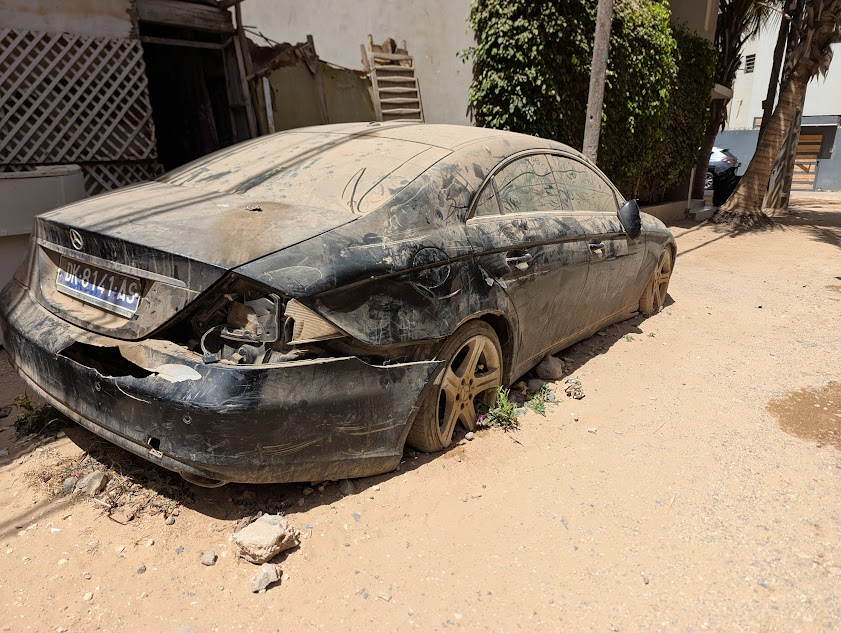
Dakar you will notice cars abandoned, as there is no means to repair them so they just get left behind.
One of the most prominent reminders of both ambition and irony in this city is the African Renaissance Monument. A towering 52-meter hunk of brass, it was built by North Korea in exchange for land after the Senegalese government struggled to finance its own vision. Designed to be a symbol of African pride, it stands over Dakar like a misplaced titan—majestic, but also a reminder of how deeply dependent nations still are on external forces.
I couldn’t help but reflect on history, specifically how financial control has long been used as a tool of subjugation. Looking back at Medina during the time of the Prophet Muhammad, a striking parallel emerges.
The conflict between the Muslim community and the Jewish tribes of Medina—most notably Banu Qaynuqa, Banu Nadir, and Banu Qurayza—was not simply a religious divide. These Jewish tribes had significant economic power in Medina, largely through trade, moneylending, and financial dealings. Islam strictly prohibited riba, which refers to excessive interest or usury, as it was seen as exploitative and destabilizing for society. There are accounts that suggest some Jewish moneylenders charged high-interest rates, which created a cycle of perpetual debt, but this was not the sole reason for their expulsion.
Tensions escalated due to political and military conflicts. Banu Qaynuqa was expelled after violating their alliance with the Muslims and showing open hostility. Banu Nadir was removed following a failed assassination attempt on the Prophet. The final battle was against Banu Qurayza in 627 CE, after they broke their neutrality agreement and conspired with the Quraysh, Medina’s enemies, to attack the city during the Battle of the Trench. After the Muslims successfully defended Medina, the siege of Banu Qurayza ended in their surrender. Their fate was decided according to the ruling of a former ally from the Aws tribe, following Jewish legal tradition. The men were executed, and the women and children were taken captive.
This battle was not merely a military confrontation; it was an economic and political struggle over control and financial influence. Islam’s stance against interest-based debt systems was a direct challenge to financial models that benefited a select few at the cost of many. Today, developing nations face a similar challenge under the grip of global financial institutions.
Fast forward to today, and the same patterns repeat themselves. The IMF and World Bank extend massive loans to countries like Senegal and Pakistan, saddling them with debt that comes with impossible conditions—forcing them to privatize essential services, sell off national assets, and keep their economies perpetually weak. Instead of outright colonization, the new model is financial servitude.
Muammar Gaddafi saw this coming. His vision for a gold-backed African Dinar was an attempt to break away from the dependency on Western-controlled financial institutions. He wanted African nations to trade among themselves using a currency that wasn’t tied to the US dollar or the Euro. But as history shows, those who resist the system often meet a brutal end. Gaddafi was overthrown and killed in 2011, and Libya descended into chaos. His dream of a unified Africa, independent of Western control, was buried with him.
But what about the people? What is the impact of these global financial manipulations on the streets of Dakar?
Walking through the city, my eyes watered—not from the dry air or the dust, but from the stark contrast I saw. Here were beautiful, strong, and resilient people struggling under a system that has refused to let them thrive. The colonial rulers may have left, but new masters remain—hidden behind debt agreements, development loans, and economic “assistance” that ensures nothing ever changes.
And yet, in the face of it all, I saw strength.
One of the things that struck me was the sheer physical energy of young Senegalese men. Coming back from the so-called Pink Lake, which was not pink at all and felt like a complete tourist trap, I noticed something far more impressive. Groups of young Senegalese men training, running, lifting weights, working out together. Their focus wasn’t on chasing Western luxuries, watching media garbage, or sinking into a cycle of consumption. They were investing in what is truly the greatest wealth—health.
And that made me wonder—maybe there is hope.
The African Renaissance Monument may stand tall, but the real African Renaissance will come from the people. The IMF, foreign economic policies, and corrupt leadership may keep them down, but as long as there is resilience, there is resistance. The strength of the human body and mind is a power that no financial institution can break.
The battle for freedom never ended. It just took a different form. And in that battle, as in Medina, as in Libya, only those who control their own fate will truly win.
خُدی کو کر بلند اتنا کہ ہر تقدیر سے پہلے
خدا بندے سے خود پوچھے بتا، تیری رضا کیا ہے
“Raise yourself so high that before destiny takes its course,
God himself asks, ‘What is your will?’”
ارفع نفسك إلى مستوى عالٍ جدًا بحيث يسأل الله نفسه قبل أن يقرر مصيرك:
“أخبرني، ما هي إرادتك؟”
 Halai
Halai 
Leave a comment