For worldschooling families, one of the most important things to figure out is how to access money efficiently while traveling. If you rely on a traditional bank account from Canada or the USA, you’ll quickly find that fees can add up through ATM charges, poor exchange rates, and international transaction fees.
After some trial and error, I discovered that services like Ria, Remitly, and Xoom are far better than traditional banks when transferring money to places like Morocco, Mauritania, and Senegal. These services, often called Fintech (financial technology) companies, operate with much lower overhead than banks, allowing them to offer better exchange rates and lower fees.
But how do these services work? And how does Fintech in Africa differ from what we see in North America?
Why Fintech is Disrupting Traditional Banks
Traditional banks have been the main way to move money internationally for decades, but they have high operational costs because of:
- Physical branches that require rent, maintenance, and staff
- Outdated technology infrastructure that is expensive to maintain
- Strict regulations and bureaucracy that slow down transactions
Fintech companies like Ria, Remitly, and Xoom are more agile and don’t have physical branches in every country. Instead, they partner with local money pickup locations like Wafa Cash in Morocco or Orange Cash in Senegal to distribute cash.
Comparing Bank Transfers vs. Fintech Transfers
| Feature | Bank Transfer | Ria, Remitly, Xoom |
|---|---|---|
| Fees | High (Bank Fees + Exchange Rate Fees) | Lower (Small transaction fee + Competitive exchange rates) |
| Transfer Speed | 2-5 Days | Instant to 24 Hours |
| Accessibility | Requires a local bank account | Can be picked up in cash |
| Overhead Costs | High (Branches, ATMs, Staff) | Low (Tech-based, fewer employees) |
| Exchange Rates | Often poor | More competitive |
For worldschoolers traveling through Africa, using Fintech over banks is an easy way to save money and access cash faster.
Spotlight on Wafa Cash – Morocco’s Leading Money Transfer Service
In Morocco, one of the biggest money transfer providers is Wafa Cash, a subsidiary of Attijariwafa Bank, one of the largest banks in North Africa.
Wafa Cash acts as a middleman for international money transfers. It allows people to receive cash from Fintech platforms like Ria, Remitly, and Xoom. Wafa Cash has hundreds of locations across Morocco where money can be picked up instantly. It serves a large number of unbanked Moroccans who don’t have traditional bank accounts.
Wafa Cash makes money in three ways. First, it takes a small cut from the currency conversion when people receive money. Second, Fintech companies like Ria, Remitly, and Xoom pay Wafa Cash a commission for every successful transfer. Lastly, some Wafa Cash locations offer small loans and savings accounts, making them an entry point for people to join the banking system.
What is Orange Cash in Senegal?
In Senegal, another popular Fintech service is Orange Cash, a mobile money service run by Orange, the French telecommunications giant. Unlike Wafa Cash, which requires cash pickup, Orange Cash is a mobile wallet where users can receive, store, and spend money digitally. It allows people to send money, pay bills, and even withdraw cash from agents without needing a traditional bank account. Many workers receive salaries through Orange Cash instead of bank deposits.
In many African countries, people don’t trust traditional banks or don’t have easy access to them. Instead, they rely on mobile money, which allows them to store and spend money directly from their phones. In contrast, mobile payments in the USA and Canada are slow to grow because people already have easy access to credit cards and bank accounts. In Africa, mobile money is the main way people access financial services.
How Can Young Worldschoolers Make Money While Traveling?
While this blog is focused on getting money while traveling, a key lesson for worldschoolers is how to earn money on the road.
Ways Kids & Teens Can Earn Money While Worldschooling
Children as young as six can start learning about money by finding creative ways to earn it while traveling.
For kids aged 6-10, they can sell drawings and crafts at local markets, take simple photos and sell them online, or offer small services like translation help if they know multiple languages…
For those aged 10-14, they can start making money online or through hands-on work. They can blog or vlog about their worldschooling journey, freelance write for kid-friendly websites, pet sit for expats, or sell digital art on platforms like Redbubble. They can also think of solutions that are sustainable yet can be profitable, for example when they travel they can see what is abundant in one place and scare in the other, Figure out transportation and logistics and see if there is anything left at the end to be called profit.
For teens aged 15-18, they can start earning real income through freelancing on Fiverr or Upwork, managing social media for small businesses, tutoring online, setting up an online store with print-on-demand products, or learning web development. They can also start investing in ideas or small businesses they see along their journey and start learning the concepts of investments. Learn about trade, real estate and possibly starting a small scale business in knowing what they know about different markets. For example, an authentic African art piece might not be much $ in a fishing village in Senegal, but in a boutique shop in NYC it might be worth a pretty penny, connecting the dots between those…
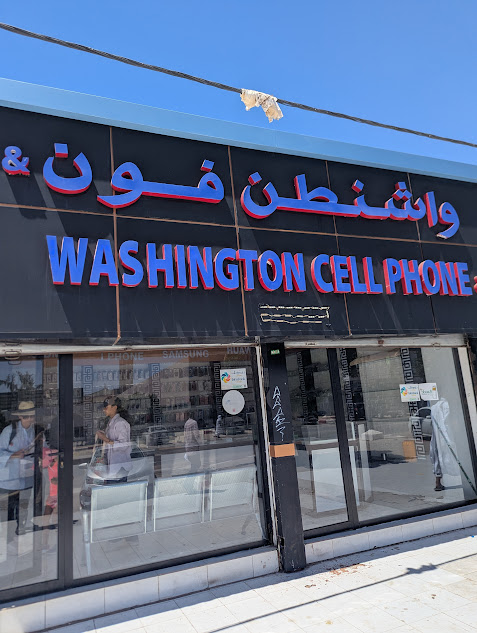
Below: Not sure when George Washington came to Mauritania but this was in the cellphone market in Nouakchott
Conclusion: Why Africa is Special
Africa is not what the West has painted it to be. The image of a continent filled with hunger, poverty, and despair is a false narrative that has been pushed for years. The truth is that Africa is the real land of opportunity. It is home to some of the fastest-growing economies, a young and vibrant population, and a level of innovation that is transforming the world.
Africa’s Fintech sector is proving that it does not need to follow the Western model of banking. It is creating its own systems, designed for its people, and leapfrogging over outdated financial structures. Mobile money, microfinance, and cash transfer services are empowering millions who were once excluded from the global economy.
For worldschoolers, there is no better place to learn about business, resilience, and economic transformation. Africa is not just a place to visit. It is a place to understand, to embrace, and to learn from. The more we open our eyes, the more we realize that the future does not belong to those who control the past but to those who innovate for the future.
 Halai
Halai 
Leave a comment