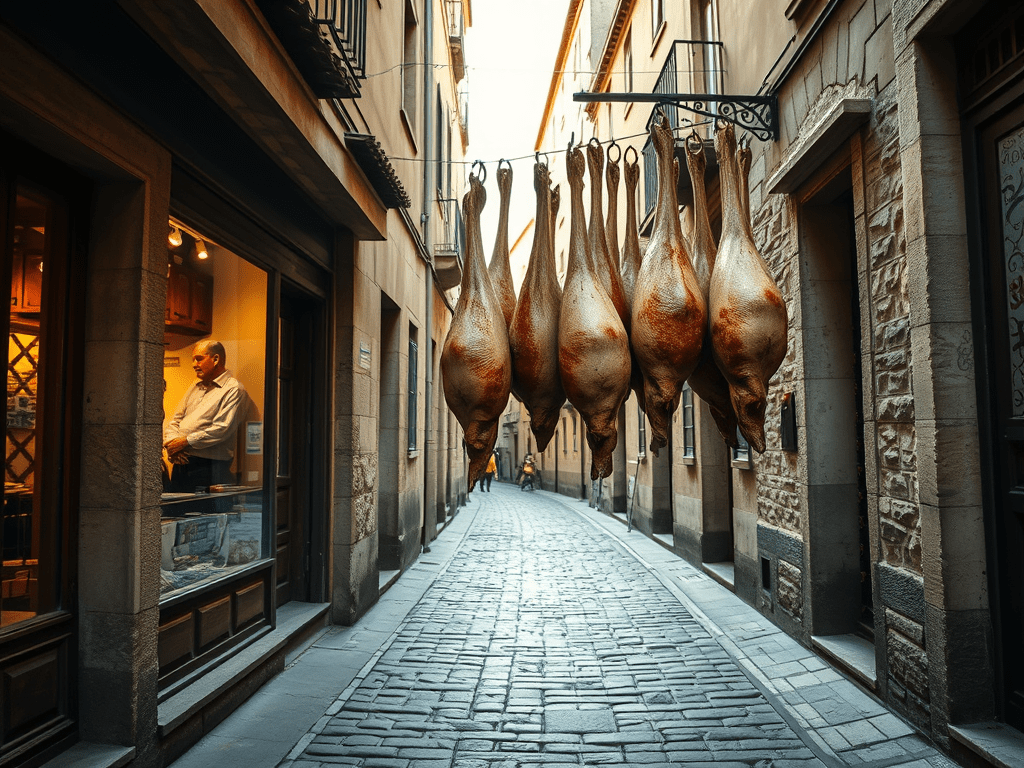
Walk through the narrow streets of Granada, and you’ll see something strange hanging in shopfronts—entire pig legs, hoof and all, suspended like some grotesque medal of victory. For the modern traveler, it might seem like just another cultural quirk. But to understand the layers behind these hoofed relics, you need to journey back over 700 years, to one of the most defining (and bloody) chapters in European history: The Reconquista.
What Was the Reconquista?
The Reconquista—literally “the reconquest”—was a centuries-long campaign by Christian kingdoms to reclaim the Iberian Peninsula from Muslim rule. Muslim forces from North Africa, known as the Moors, had swept into Spain in 711 AD, establishing Al-Andalus, a flourishing Islamic civilization that at its peak covered most of Spain and Portugal. For over 700 years, this part of Europe was a cultural crossroads of Muslim, Christian, and Jewish life.
But by the 11th century, Christian kingdoms in the north began to push back. The Reconquista wasn’t a single war, but a series of military campaigns, alliances, betrayals, and religious fervor that dragged on until 1492, when the Catholic monarchs, Ferdinand of Aragon and Isabella of Castile, finally captured Granada, the last Muslim stronghold.
That date—1492—is no coincidence. It’s also the year Columbus “discovered” the Americas. Spain, having purged itself of Muslims, Jews, and religious diversity, was now poised to become a global empire.
Why Was It a “Victory for All of Europe”?
In the Christian worldview of the time, the Reconquista wasn’t just a Spanish affair—it was a holy war for the soul of Europe. Popes declared it a crusade, knights from across the continent joined the cause, and its conclusion was hailed as the final push against centuries of Muslim dominance in European lands.
To the Christian kingdoms, reclaiming Granada in 1492 symbolized:
- The triumph of Christendom over Islam.
- A unified Spain, no longer fractured by religious pluralism.
- A moral and spiritual victory, celebrated across European courts and churches.
How Bloody Was It?
Let’s not romanticize it. The Reconquista was violent, relentless, and deeply brutal.
- In 1085, the capture of Toledo saw thousands of Muslims flee or be massacred.
- The Battle of Las Navas de Tolosa (1212) was one of the bloodiest in medieval history.
- The final conquest of Granada in 1492 was followed by a massive purge of Muslims and Jews, despite initial promises of religious tolerance.
By 1502, Muslims in Castile were forced to convert to Christianity or face expulsion. By 1609, even the converted Moriscos were expelled en masse.
The Spanish Inquisition—infamous for its torture and persecution—was launched shortly after the Reconquista to root out “fake” converts. The message was clear: be Christian, or be gone.
Pork as a Weapon: The Strange Politics of the Pig
So, about those hanging pig legs…
In post-Reconquista Spain, public displays of eating pork became a loyalty test. Muslims (and Jews) do not eat pork for religious reasons. By showcasing pig legs, Christian Spaniards could prove they weren’t secret Muslims or Jews.
It was a cultural litmus test: if you didn’t eat pork, you were suspect.
This symbolism spread far beyond food:
- Shops hung pig legs not just for sale, but as a message: “No Muslims here.”
- Converts were watched closely—did they eat pork at public feasts? Did they avoid it at home?
Even architecture changed—pork motifs and grotesque pigs were carved into some church facades as a way to declare religious “purity.”
Did the British Use the Same Trick in India?
Yes—chillingly, history repeated itself.
During the Indian Rebellion of 1857, Indian soldiers (both Hindu and Muslim) in the British East India Company army were issued new rifle cartridges rumored to be greased with cow and pig fat. Hindus consider the cow sacred; Muslims avoid pigs. Biting the cartridge to load the gun violated both groups’ beliefs.
The British claimed ignorance. Indians suspected it was a deliberate attempt to humiliate and control them—and they revolted. While this rebellion had many causes, the greased cartridge controversy was a powerful spark, echoing Spain’s own use of pork as a symbol of dominance.
Why Were Ferdinand and Isabella So Revered?
Ferdinand and Isabella are hailed in Spanish history as the Reyes Católicos—the Catholic Monarchs. To Catholic Europe, they were heroes who:
- United Spain under one crown and one religion.
- Defeated the last Islamic kingdom in Europe.
- Expelled the Jews (with the Alhambra Decree).
- Sponsored Columbus’s voyage and launched the Spanish Empire.
But from a modern perspective, their legacy is far more complex—marked not just by victory, but by ethnic cleansing, forced conversions, and the loss of one of the most multicultural societies Europe had ever known.
So What Happened Next? Spain’s “Golden Age”
With Muslims and Jews gone, Spain entered its so-called Golden Age (Siglo de Oro)—a time of global conquest, unimaginable wealth from the Americas, and flourishing art, architecture, and literature.
But this “golden” era was built on:
- Colonial exploitation.
- Religious homogeneity enforced by fear.
- Cultural amnesia, forgetting that Spain’s greatness once lay in its pluralism.
Final Thoughts: Granada, Then and Now
Standing in Granada today, surrounded by the remnants of Islamic architecture, Moorish poetry, and yes—those pig legs—one can’t help but feel haunted by history.
Spain’s Reconquista was more than a military campaign—it was a cultural transformation. One that erased, rewrote, and then mythologized its past.
As a worldschooler, entrepreneur, or traveler, understanding this history isn’t about taking sides. It’s about remembering how culture, food, religion, and power intertwine—and how even something as ordinary as a pig leg can carry centuries of meaning.
 Halai
Halai 
Leave a comment