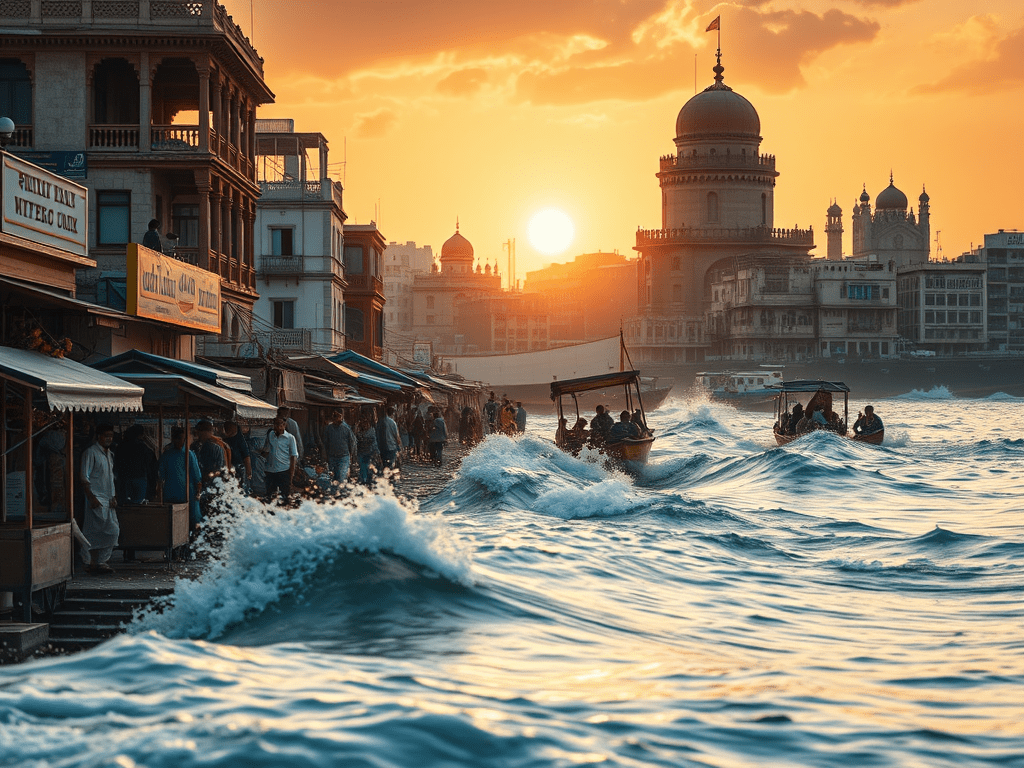
The more cities I see—Rome, Granada, Fez —the more I realize how much Karachi is woven into my soul. Even after living three decades in Canada and traveling across continents, my heart never really left Karachi. Most people I know saw Karachi as a place to escape—a stepping stone to a better life abroad. But for me, it’s never been that simple.
I’ve always felt an unshakable connection to this city. I’ve tried to understand why. Maybe it’s in the bones. Maybe it’s in the stories. Maybe it’s because, for my family, Karachi wasn’t a place we landed in by accident—it was home long before Pakistan existed.
My father’s side settled in Karachi around 1797, back when it was a thriving port town under the Talpur dynasty—long before the British set their sights on it. At the time, Karachi was perhaps what Dubai is today: a coastal hub of trade, energy, and opportunity. Merchants from across the region passed through here. Money moved. Cultures collided. And our family found its footing here in this golden era of Karachi’s history.
Fast forward to the early 1900s. During a renovation of our home in Richmond Hill, Ontario, we uncovered layers of old insulation. Inside was a 1927 newspaper from when Karachi made headlines—not for violence or unrest, but for innovation. The British Empire had just established an international air route that passed through Karachi—a major logistical victory. Karachi wasn’t just connected to the world; it was essential to it.
Then came Partition in 1947.
Karachi, like the rest of South Asia, was never the same again. Hindus who had lived in the city for generations left en masse. Many of their properties and businesses were abandoned, creating both a vacuum and an opportunity. Entrepreneurs in my family, like many others, stepped in—but the soul of the city shifted. It had been torn in half.
As millions of Muhajirs—Muslims migrating from India—arrived in Karachi, they brought talent, culture, and dreams, but were often treated like outsiders in their new home. Other provinces, especially Punjab, weren’t as welcoming. Karachi opened its doors. These migrants built neighborhoods out of nothing—Lines Area, PIB Colony, Nazimabad, Korangi. They rebuilt their lives with dignity, despite discrimination and exclusion from power structures.
In the 1970s, after the fall of Dhaka, waves of Bengali-speaking migrants arrived. Then Afghans during the Soviet war. Then Biharis from refugee camps. Karachi absorbed them all. The city never stopped morphing. It’s messy, overwhelming, contradictory—and deeply alive.
And yet, I now realize I never truly saw Karachi. I lived inside a bubble: sheltered, selective, fearful. But as I travel the world and study cities that wear their histories proudly—whether Rome’s ruins or Granada’s Alhambra—I realize how little of my own city I’ve understood.
I’m excited to go back—not to the Karachi I thought I knew, but to explore the other Karachis: the ones I never dared to see. Because somewhere in its noise and neglect, I believe Karachi still holds its soul.
It has stories left to tell. And I finally have the ears—and the heart—to listen.
- Comment
- Reblog
-
Subscribe
Subscribed
Already have a WordPress.com account? Log in now.
 Halai
Halai 
Leave a comment