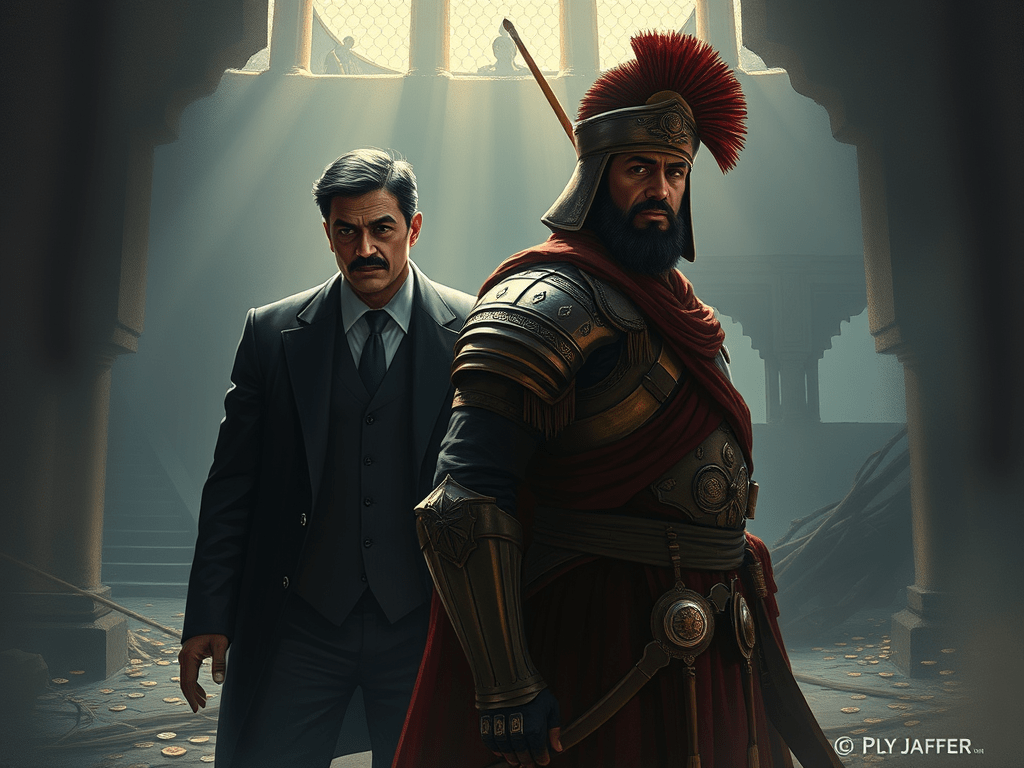
Today, I want to write about me—not in the personal sense, but in the sense of a type: the Mir Jaffer. The one who betrays his own people, sells his soul, and opens the gates to the enemy in exchange for titles, palaces, and petty power.
History remembers Mir Jaffer for betraying Siraj-ud-Daulah at the Battle of Plassey, which allowed the British East India Company to take over Bengal—and eventually, all of India. But he is not alone. Every culture has its own Mir Jaffers: the African tribal chiefs who sold their people into slavery, the senators like Brutus who stabbed Caesar in the back, the generals who switched sides at critical moments.
They wear different clothes, speak different languages, but they are the same. They exist in my homeland of Pakistan too. After living 30 years in Canada and returning here with fresh eyes, I now see a country not just struggling, but being actively looted by its own elite. These are the Mir Jaffers of today—politicians, army generals, business moguls—those who take bribes, lie to the poor, siphon wealth, and hide it in Dubai, London, or New York. They are not leaders. They are facilitators of decay.
What is their psychology?
How does one come to betray their own people so deeply and still live with themselves? Is it greed? Fear? Delusion? Or perhaps the illusion that siding with the powerful will protect them from the storm they helped create?
And then I think of Tipu Sultan. A man who fought with everything he had, who died with a sword in his hand, who refused to bow. His famous quote echoes louder now than ever:
“It is better to live one day as a lion than a hundred years as a jackal.”
He was surrounded by jackals. And it was one of his own who opened the door to the enemy.
Even in Islam’s own deep historical traditions, this betrayal repeats itself. The Battle of Karbala was not just a clash of armies—it was a moment of moral clarity. General Hur defected from the corrupt Yazidi army to join Imam Hussain, choosing righteousness even when it meant certain death. That is the opposite of Mir Jaffer. That is the choice of the lion.
This worldschooling journey with my family has shown me ruins and relics, palaces and prisons—but it is the patterns I now see. In Italy, the fountains of Tivoli were built on wealth extracted from colonies. In every empire, luxury flows from betrayal.
And so, as I look around the world and within myself, I ask: Am I the one who resists, or the one who enables?
Are we building legacies of resistance or palaces of corruption?
Because make no mistake: the Mir Jaffers still walk among us.
–
The Mir Jaffers Among Us
 Halai
Halai 
Leave a comment